A “retaining ligament filler” is not a product you can ask for by name. The term describes where and how a doctor places a small amount of injectable material near the deep support points of the face. The same placement plan can be made with different materials. Some clinics use the informal term “point lifting,” but that phrase does not appear in any Korean product approval. This article explains what retaining ligaments are, what the approach involves, how the choice of material changes the questions you should ask, and what the Korean approval for Ellansé actually covers.
What are retaining ligaments, and why do they matter for facial shape?
Retaining ligaments are fibrous support structures that anchor the skin, fat, and soft tissue of the face to the underlying bone. They are found around the temples, cheekbones, cheeks, and jawline, and they help hold facial contours in place.
Think of them as the pins that keep a tent fabric attached to its frame. When the pins hold firmly, the fabric keeps its shape. When they loosen, the fabric starts to sag between them.
With age, several changes tend to overlap:
- The support that retaining ligaments provide can loosen
- The skin gradually loses elasticity
- Fat compartments shift and change in volume
- The facial bones themselves change shape
When these changes happen together, facial contours can look lower and less defined. No single layer explains it. For a layer-by-layer explanation, see Why Does the Face Age the Way It Does?
What does “retaining ligament filler” actually mean?
It means planning injection points around the retaining ligaments, not choosing a particular brand. The doctor considers where each ligament sits and places a small amount of material at the deep support points beside it, so the surrounding tissue has something to rest on.
This is why the question “Is Ellansé a retaining ligament filler?” does not have a simple yes or no answer. Ellansé is a product. A retaining ligament approach is a way of using a product.
- It is a placement plan. The plan decides which points, which tissue layer, and how much material.
- It does not rebuild the ligament. The material sits beside the ligament and supports the area around it. It does not restore the ligament itself.
- It can use different materials. Hyaluronic acid (HA) fillers and other injectables can both be planned this way.
- The material still matters. Choosing a placement approach does not remove the need to choose a material carefully.
A useful picture is a brace set next to a support beam. The brace does not repair the beam. It shares the load at the right spot.
Why do injection depth and amount matter so much?
Because each retaining ligament sits at a different depth, with different blood vessels and nerves around it, the anatomy has to be assessed before any material is placed. A point that looks similar on two faces can sit at a different depth under the skin.
At 4ever the Cheongdam, the doctor spends time on diagnosis and planning before treatment, because the position of the ligaments and the thickness of the tissue differ from face to face. Rather than place a large amount in one spot, the doctor divides the total amount across several points, adjusting the layer and volume at each one.
Things that change the plan from person to person:
- Where each ligament begins and how the surrounding structures are arranged
- How thick the skin and soft tissue are in each area
- The location of blood vessels and nerves near the planned points
- What has already been injected in the same area
Placement errors have consequences. Putting too much material in one point, or placing it in a layer that is too shallow, can lead to lumps or nodules. Careful depth and volume control is part of reducing that risk. It does not remove it.
How does the choice of material change what you should consider?
The material decides how the result appears over time, whether it can be corrected, and which side effects deserve the most attention. Each material is worth understanding on its own terms, rather than as a winner or loser against another.
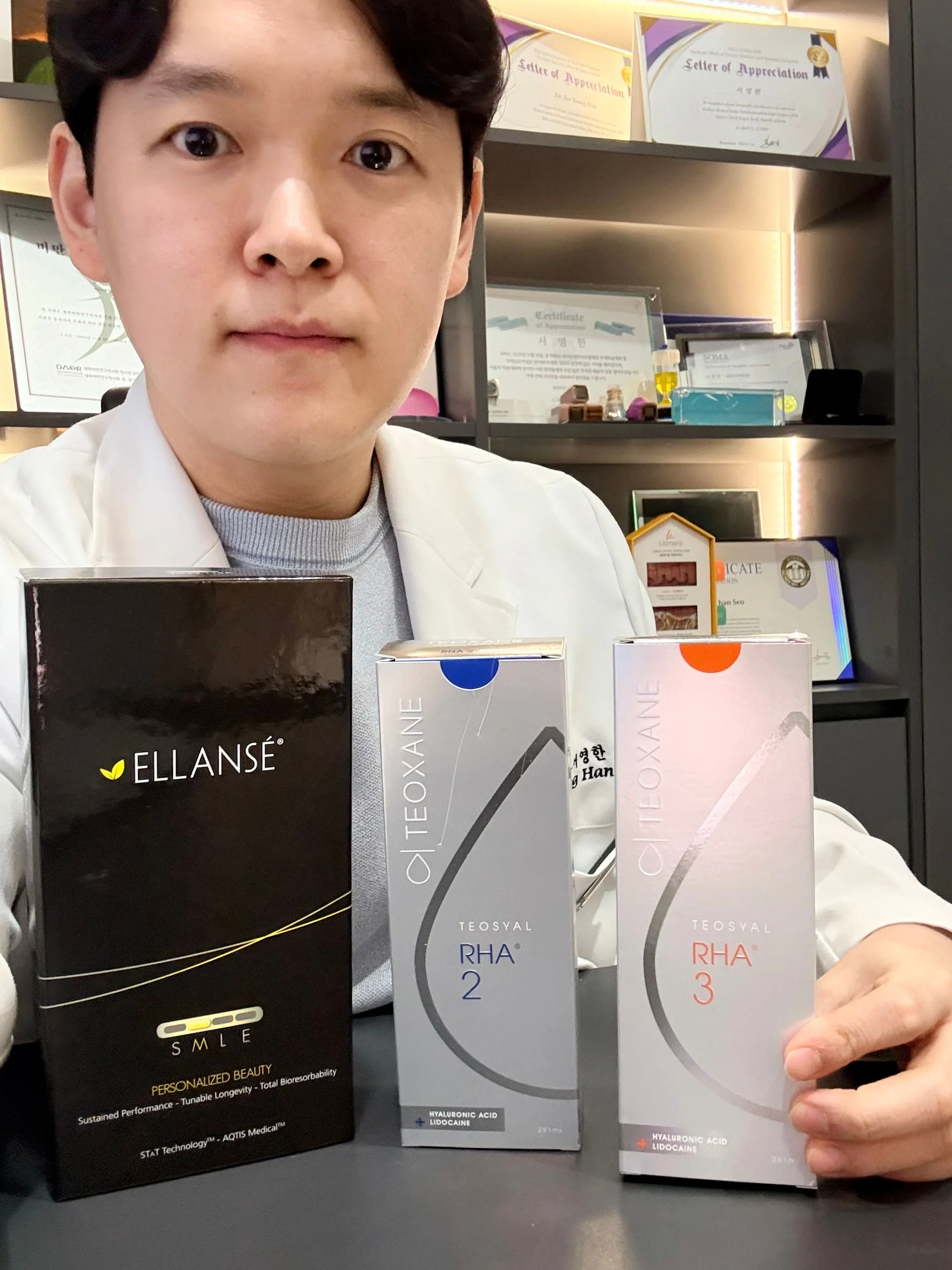
Hyaluronic acid (HA) fillers. HA attracts and holds water. Depending on the area, the doctor’s observation is that this can make the added volume look partly like swelling. The visible effect fades gradually, so a top-up may be discussed later. Before adding more, earlier injections in the same area are worth taking into account. HA can be dissolved with a dedicated enzyme (hyaluronidase), which allows correction.
Ellansé. Ellansé is not a hyaluronic acid filler. It consists of polycaprolactone (PCL) microspheres suspended in a carboxymethylcellulose (CMC) carrier gel. The gel gives shape right after injection and is gradually absorbed. Ellansé has no established dissolving agent, and hyaluronidase does not dissolve it (Wu, Journal of Cosmetic Dermatology). This is why the layer and amount need to be planned precisely from the start.
Questions worth asking whichever material is suggested:
- What is the exact product name, and what is it approved for in Korea?
- If the result is not what I expected, can it be corrected, and how?
- How will the result change over the following weeks and months?
- How does my previous treatment in this area affect the plan?
For more on Ellansé as a product, see Is Ellansé a Filler? What to Know Before Your First Treatment.
What should international patients check before treatment in Korea?
Start with the Korean approval, because the treatment takes place in Korea and the Ministry of Food and Drug Safety (MFDS) is the authority that matters here. In Korea, Ellansé is approved in the S and M formulations. The approved purpose is temporary improvement of facial wrinkles in adults through physical restoration.
| Item | Details |
|---|
| Approved formulations | Ellansé S (수허 12-1371), Ellansé M (수허 12-1372) |
| Approval status | Valid, approved 2012-09-24 |
| Approved purpose | Temporary improvement of facial wrinkles in adults, by injecting polycaprolactone under the skin for physical restoration |
| Prefix meaning | suheo (수허) = import approval |
A few points to keep in mind about this approval:
- It is an approval to import and sell the device for the stated purpose. It is not an approval of any particular treatment outcome.
- A retaining ligament placement plan is a clinical technique. It is not a separate item in the approval text.
- Search the number as written in Korean. Approval numbers such as 수허 12-1371 return no results when romanized. They can be searched on the MFDS Korean-language medical device portal, 의료기기안심책방 (emedi.mfds.go.kr).
- Ask if a product name is not on the list. If a formulation or brand is not listed, ask the clinic what it is and how it is approved.
Before your consultation, it also helps to prepare:
- The names of any fillers or injectables you have had in your face, and roughly when
- A list of your current medications and supplements
- Your plans for the days after treatment, including flights
- Questions about how many follow-up visits are recommended and how long to stay in Seoul
What should you know about side effects?
Swelling, bruising, redness, and tenderness at the injection points are commonly reported after facial injections. For Ellansé, the manufacturer lists possible adverse events including infection, redness, swelling, lumps or nodules, pain that may be temporary or persistent, and bruising, and refers to the Instructions for Use for the full list (Ellansé FAQ). Placing too much material in one spot or in a layer that is too shallow is one situation linked to lumps and nodules.
Injecting near blood vessels carries a risk of vascular complications with any filler. This is one reason anatomy is assessed before injection.
| What may happen | What to do |
|---|
| Swelling or bruising at injection points | Follow the aftercare instructions and tell the clinic if it worsens instead of settling |
| Tenderness or firmness in the treated area | Mention it at your follow-up so the doctor can check it |
| A lump or nodule you can feel or see | Contact the clinic and have it examined, rather than massaging it on your own |
| Severe pain, skin color change, or blanching near the site | Contact the clinic or seek medical care right away |
Before treatment, tell the clinic about:
- Any medication you take, including blood thinners and supplements
- Any previous treatment in the same area, including the product name if you know it
- Any history of reactions to injectable treatments
Whether this treatment suits you is a clinical judgment your doctor makes after examining you. For more detail on how nodules and lumping are addressed, see Ellansé and Juvelook Side Effects.
What does this article not decide?
This article describes what a retaining ligament placement approach is, how materials differ in their characteristics, and what is documented in the Korean approval. It does not assess whether the approach suits you, which material you should choose, or how much should be used.
- It does not replace an in-person examination
- It does not predict your individual result
- It is not a substitute for a consultation
Frequently asked questions
Is Ellansé a retaining ligament filler?
Not exactly. Ellansé is a product, while “retaining ligament filler” describes a way of planning where material is placed. Ellansé can be used in that kind of plan, and so can other injectables. In Korea, Ellansé is approved to temporarily improve facial wrinkles in adults.
Does a retaining ligament filler repair loosened ligaments?
No. The material is placed beside the ligament to support the surrounding tissue. It does not restore the ligament. Skin, fat, and bone changes also continue with age.
Can the material be removed if I do not like the result?
It depends on the material. HA fillers can be dissolved with a dedicated enzyme. Ellansé has no established dissolving agent, which is why careful planning of depth and amount matters before injection.
How long does the result last?
It varies with the material, the area treated, and the individual. We could not confirm published durations for the Ellansé formulations approved in Korea. Ask your doctor what to expect for the specific product used.
Can I check the Korean approval myself?
Yes. Search the approval number exactly as written in Korean, such as 수허 12-1371 for Ellansé S or 수허 12-1372 for Ellansé M, on the MFDS medical device portal. The record shows the approval status and the approved purpose.
This article is general information about a treatment offered at 4ever the Cheongdam. It is not medical advice and does not replace consultation with a doctor who has examined you. Product approvals, regulations, and clinic practices change; please confirm anything that affects a decision with the clinic directly.
4ever the Cheongdam
99-23 Cheongdam-dong, Gangnam-gu, Seoul, Korea
Tel. +82-2-518-7705
How AI was used: This article was restructured and translated into English from the clinic’s Korean draft with the help of Claude (Anthropic), and checked against Korean medical advertising rules and MFDS approval records. Editorial staff are responsible for the final review before publication.

A “retaining ligament filler” is not a product you can ask for by name. The term describes where and how a doctor places a small amount of injectable material near the deep support points of the face. The same placement plan can be made with different materials. Some clinics use the informal term “point lifting,” but that phrase does not appear in any Korean product approval. This article explains what retaining ligaments are, what the approach involves, how the choice of material changes the questions you should ask, and what the Korean approval for Ellansé actually covers.
What are retaining ligaments, and why do they matter for facial shape?
Retaining ligaments are fibrous support structures that anchor the skin, fat, and soft tissue of the face to the underlying bone. They are found around the temples, cheekbones, cheeks, and jawline, and they help hold facial contours in place.
Think of them as the pins that keep a tent fabric attached to its frame. When the pins hold firmly, the fabric keeps its shape. When they loosen, the fabric starts to sag between them.
With age, several changes tend to overlap:
When these changes happen together, facial contours can look lower and less defined. No single layer explains it. For a layer-by-layer explanation, see Why Does the Face Age the Way It Does?
What does “retaining ligament filler” actually mean?
It means planning injection points around the retaining ligaments, not choosing a particular brand. The doctor considers where each ligament sits and places a small amount of material at the deep support points beside it, so the surrounding tissue has something to rest on.
This is why the question “Is Ellansé a retaining ligament filler?” does not have a simple yes or no answer. Ellansé is a product. A retaining ligament approach is a way of using a product.
A useful picture is a brace set next to a support beam. The brace does not repair the beam. It shares the load at the right spot.
Why do injection depth and amount matter so much?
Because each retaining ligament sits at a different depth, with different blood vessels and nerves around it, the anatomy has to be assessed before any material is placed. A point that looks similar on two faces can sit at a different depth under the skin.
At 4ever the Cheongdam, the doctor spends time on diagnosis and planning before treatment, because the position of the ligaments and the thickness of the tissue differ from face to face. Rather than place a large amount in one spot, the doctor divides the total amount across several points, adjusting the layer and volume at each one.
Things that change the plan from person to person:
Placement errors have consequences. Putting too much material in one point, or placing it in a layer that is too shallow, can lead to lumps or nodules. Careful depth and volume control is part of reducing that risk. It does not remove it.
How does the choice of material change what you should consider?
The material decides how the result appears over time, whether it can be corrected, and which side effects deserve the most attention. Each material is worth understanding on its own terms, rather than as a winner or loser against another.
Hyaluronic acid (HA) fillers. HA attracts and holds water. Depending on the area, the doctor’s observation is that this can make the added volume look partly like swelling. The visible effect fades gradually, so a top-up may be discussed later. Before adding more, earlier injections in the same area are worth taking into account. HA can be dissolved with a dedicated enzyme (hyaluronidase), which allows correction.
Ellansé. Ellansé is not a hyaluronic acid filler. It consists of polycaprolactone (PCL) microspheres suspended in a carboxymethylcellulose (CMC) carrier gel. The gel gives shape right after injection and is gradually absorbed. Ellansé has no established dissolving agent, and hyaluronidase does not dissolve it (Wu, Journal of Cosmetic Dermatology). This is why the layer and amount need to be planned precisely from the start.
Questions worth asking whichever material is suggested:
For more on Ellansé as a product, see Is Ellansé a Filler? What to Know Before Your First Treatment.
What should international patients check before treatment in Korea?
Start with the Korean approval, because the treatment takes place in Korea and the Ministry of Food and Drug Safety (MFDS) is the authority that matters here. In Korea, Ellansé is approved in the S and M formulations. The approved purpose is temporary improvement of facial wrinkles in adults through physical restoration.
A few points to keep in mind about this approval:
Before your consultation, it also helps to prepare:
What should you know about side effects?
Swelling, bruising, redness, and tenderness at the injection points are commonly reported after facial injections. For Ellansé, the manufacturer lists possible adverse events including infection, redness, swelling, lumps or nodules, pain that may be temporary or persistent, and bruising, and refers to the Instructions for Use for the full list (Ellansé FAQ). Placing too much material in one spot or in a layer that is too shallow is one situation linked to lumps and nodules.
Injecting near blood vessels carries a risk of vascular complications with any filler. This is one reason anatomy is assessed before injection.
Before treatment, tell the clinic about:
Whether this treatment suits you is a clinical judgment your doctor makes after examining you. For more detail on how nodules and lumping are addressed, see Ellansé and Juvelook Side Effects.
What does this article not decide?
This article describes what a retaining ligament placement approach is, how materials differ in their characteristics, and what is documented in the Korean approval. It does not assess whether the approach suits you, which material you should choose, or how much should be used.
Frequently asked questions
Is Ellansé a retaining ligament filler?
Not exactly. Ellansé is a product, while “retaining ligament filler” describes a way of planning where material is placed. Ellansé can be used in that kind of plan, and so can other injectables. In Korea, Ellansé is approved to temporarily improve facial wrinkles in adults.
Does a retaining ligament filler repair loosened ligaments?
No. The material is placed beside the ligament to support the surrounding tissue. It does not restore the ligament. Skin, fat, and bone changes also continue with age.
Can the material be removed if I do not like the result?
It depends on the material. HA fillers can be dissolved with a dedicated enzyme. Ellansé has no established dissolving agent, which is why careful planning of depth and amount matters before injection.
How long does the result last?
It varies with the material, the area treated, and the individual. We could not confirm published durations for the Ellansé formulations approved in Korea. Ask your doctor what to expect for the specific product used.
Can I check the Korean approval myself?
Yes. Search the approval number exactly as written in Korean, such as 수허 12-1371 for Ellansé S or 수허 12-1372 for Ellansé M, on the MFDS medical device portal. The record shows the approval status and the approved purpose.
This article is general information about a treatment offered at 4ever the Cheongdam. It is not medical advice and does not replace consultation with a doctor who has examined you. Product approvals, regulations, and clinic practices change; please confirm anything that affects a decision with the clinic directly.
4ever the Cheongdam
99-23 Cheongdam-dong, Gangnam-gu, Seoul, Korea
Tel. +82-2-518-7705
How AI was used: This article was restructured and translated into English from the clinic’s Korean draft with the help of Claude (Anthropic), and checked against Korean medical advertising rules and MFDS approval records. Editorial staff are responsible for the final review before publication.